Get an email when a new post is published. Confirm your email to start.
Unsubscribe anytime.
My name is Krisi…
…and I’m often in crisis (existential, interpersonal, illusory—you name it.)
Here is where I share my readings that get me through the turbulent, calm, wonderful, silly, and often comicotragic days. And you know what? I thought it would be nice to share the interesting stuff I read and my (maybe?) interesting thoughts.
Ruptures, Apricots, and Geometry: How Three Books Defined My Year
December 27, 2024 · 9 min · Krisi
As I am writing this, it is the final week of the year, it is snowing outside and in an hour from now I will be having coffee with the biggest reader of my family - my great-aunt Nina. Even though in the past months, I have felt as if I am mainlystress-reading academic articles and juggling between different responsibilities, something about this beautiful snowy morning gave me the muse to remember and share some of the wonderful books I had the privilege and pleasure of reading this past year.
To some of my friends, I am known to often cite one iconic Bulgarian rapper, Keranov, in the closing remarks of his magnum opus -Failure:
For me, it was a privilege and a pleasure… well, mostly a privilege, less of a pleasure.
Looking back at 2024, there are definitely months that felt like mostly a privilege, less of a pleasure. But if there is one thing that got me through hard times, it was the pleasure of slow reading, of leaving my phone aside and getting immersed in a book. Sometimes it was anxiously so before I go to bed, others happily in the company of a friend or my favorite matcha latte…
Far from devising a quantitative report à la “Everything I Read In 2024”, with this article I rather want to look at how the three major periods of my year can be reflected on through the lens of what I was reading at the time. While a bigger multiplicity of books could better capture each micro-krisis and each small realisation, I decided to embrace the mantra of less is sometimes more. And maybe less is much needed in a world where I saw a guy bragging on his Hinge profile with a Spotify wrapped listening time of 333 856 minutes… Or about 15 hours a day on average!
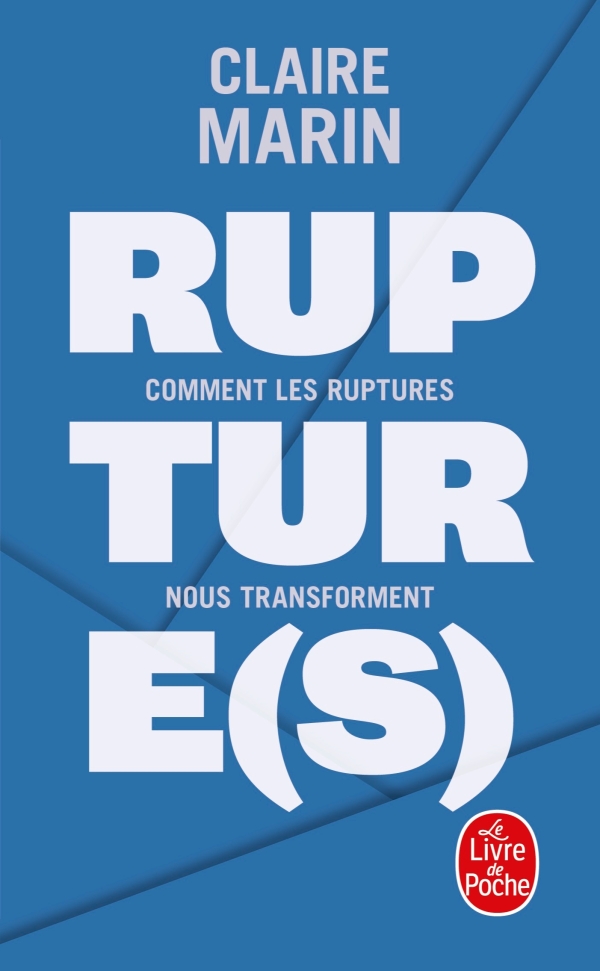
Without further ado, the first book, which was with me and helped me be in 2024 is Ruptures by Claire Marin.
Though I am unsure if I technically read it in the last weeks of 2023 or first weeks of 2024, I couldn’t help but start my wrapped-esque affair with the book that best paralleled my emotional starting point. As one might have figured by the title, my year’s beginning was marked by a rupture (my romantic breakup), the pain of which haunted me throughout the first few months of 2024.
In a nutshell, the book is an exploration of how moments of rupture, whether tolerable or violent, in good or bad spirits, visible or invisible, move us through life and shape our changing identities. Even though it is a very short read that I finished in two afternoons, it stayed with me for a long, long time.
After a relationship ends, it might feel as if a limp has been suddenly amputated. Until yesterday your world’s horizon included a particular language of inside jokes, references that have been built for long, memories and future projections. Post-rupture, one adapts to a new reality , which is full of questions and uncertainties about itself - are you funny if your main audience is no longer there to laugh? Are you a good and caring person if you no longer express love and affection towards a significant other?
Ruptures helped me connect these musings to the broader and profoundly human phenomenon of feeling a violent fracture from what used to be a constant and grappling with the unpredictable.
Marin shows how all types of ruptures are experiences of the perceived security of the oneness being split into the multiple and thus changing fundamental pillars of your identity. Imagine spending 20 years in the army and then having to start anew, moving cities, giving birth and hence rupturing with what life was before, or living through a natural catastrophe. The book asks what remains after such ruptures and what newness emanates from them?
Fast forward to… let’s say, end of May, into my Rebecca Solnit Era. Solnit is no doubt the most important author I discovered this year, one of the authors I now identify so strongly with that I almost question “Who was I before I was a Rebecca Solnit fan?”
The way Claire Marin’s Ruptures helped me navigate through the difficult feelings after a breakup and I will always connect it to that part of my path, The Faraway Nearby I associate with a way more cheerful and inspired period.
I remember being in a routine of mostly working from home, which left room for a lot of reading over lunch time or before work at my favorite coffee shop. I wouldn’t say it was a completely carefree time, but I now see how my routine of consistent reading and relative peace of mind (compared to the beginning of the year), made me receptive to reflection and a deeper staring into the world.
It was at that time that I received my first Solnit book as a gift from my dear friend and former professor, Liliane. Well, it wasn’t the title in questionbut it lit up the path towards it, for which I will be eternally grateful!
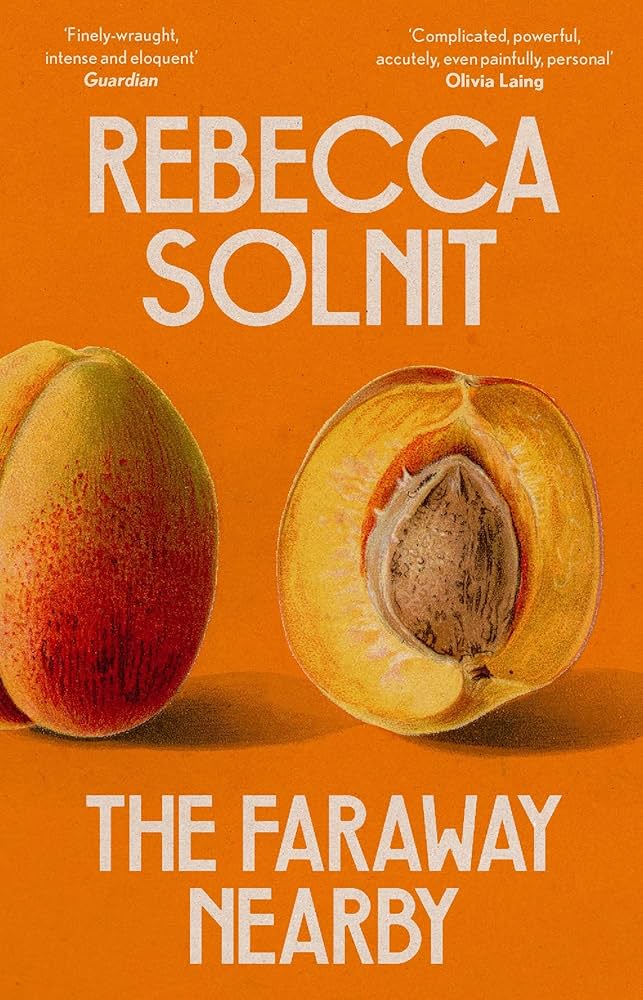
The Faraway Nearby truly touched me. Rebecca Solnit reflects on storytelling, and through her masterful intertwining of stories itself, put me in a disposition to puzzle over what is my own story. How stories that I tell myself shape me? What are the elements in my life, symbolic rather than practical, that merit a deeper look into?
Though it might seem strange, the apricots on the book’s orange cover are such an element for the author. Throughout the collection of essays, which constitute The Faraway Nearby, Solnit intertwines the experience of her mother’s worsening Alzheimer’s disease with the last harvest of her apricot tree that she “inherited”. Every time she looks at the pile of apricots she stares deeply both into their physical reality as well as their quality of a living organism that tells its own story:
This abundance of unstable apricots seemed to be not only a task set for me, but my birthright, my fairy-tale inheritance from my mother who had given me almost nothing since my childhood. It was a last harvest, a heap of fruit from a family tree, like the enigmatic gifts of fairy tales: a magic seed, a key to an unknown door, a summoning incantation. Bottling, canning, composting, freezing, eating, and distilling them was the least of the tasks they posed. The apricots were a riddle I had to decipher, a tale whose meaning I had to make over the course of the next twelve months as almost everything went wrong.
It is this level of intensity of looking that inspires me.
Know that is just a glimpse of what The Faraway Nearby. As a final temptation to inspire you to read it here are some surprising elements I bet you didn’t expect would come up such clearly personal essays: Hans Christian Andersen’s “The Wild Swans, Che Guevara’s motorcycle travels around South America, Mary Shelley’s fascinating biography as well as some disturbing yet fascinating stories of survival in Icelandic mountains…
Finally, in Solnit’s personal story during this difficult period, one special moment brings her to adopt a lasting motto: “Never turn down an adventure without a really good reason!”
I would lie if I said the words haven’t come to my mind on many, many occasions in 2024…
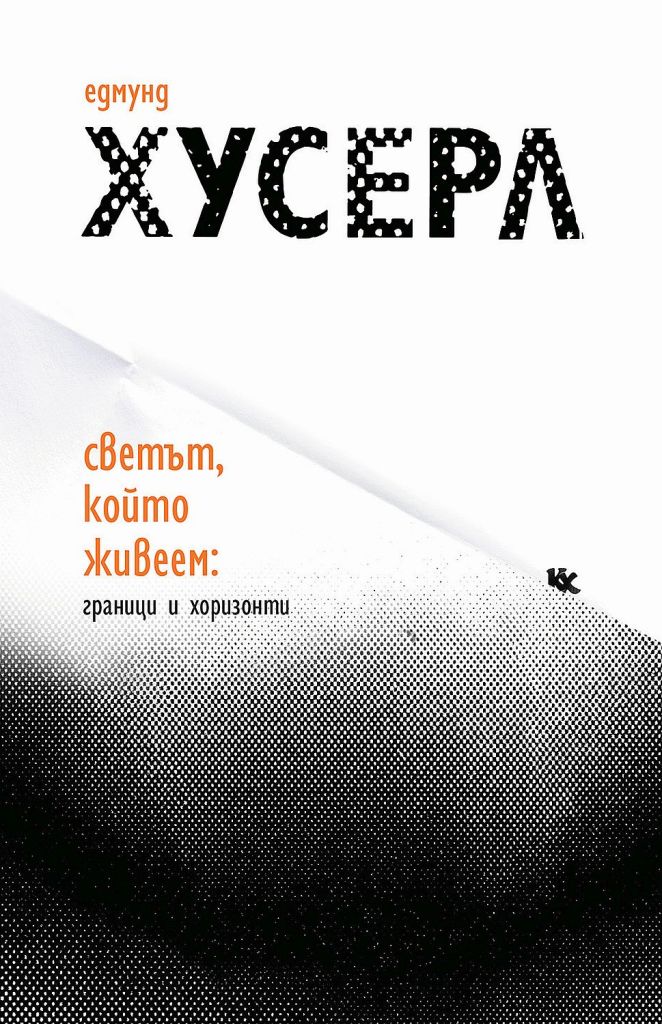
Speaking of adventures, between the beginning of September and last week, I attended a philosophy seminar focused specifically on The Origins of Geometry by Edmund Husserl!
This last text (it’s actually an essay, part of a book and different collections of his texts) I chose to share because it played a special role in the last period of the year for me - namely, my journey back to reading philosophy.
While I realize that it is now the three out of three significant reads in 2024 I have decided to share are non-fiction, I promise I am a normal human and still mostly read novels! Yet, looking back at the beginning of the year and the path I walked towards the last 3 months, it was a step by step process for me to acknowledge in front of myself that I also read real philosophy…
So, standing initially intimidated in front of my copy of The Origins of Geometry, I started reading Husserl’s attempt to find the original sense of geometry, and thus implicitly to all exact sciences. Taking the ready-made geometry we all use and starting to question backwards, he doesn’t do a historical analysis but rather a phenomenological inquiry asking: What are the conditions that allowed for ideality, which is objective for all people at all times, to come about and persist through generations?
This path of questioning turned out to be fascinating and full of paradoxes even though I am the first to admit the topic didn’t soundparticularly sexy at first…
Yet, what I love about reading and what The Origins of Geometry is a good example of, is how slowly exploring a text, reading and rereading, and discussing with others can really take you to unexpected places. I read and discussed these only around 40 pages for three whole months!
That said, what I would mostly take out of them, I believe, is the inspiration and partly the methodology for a slow and rigorous questioning of the origin and original sense of things.
For instance, at one point Husserl grapples with the issue of how geometry could be at the same time alive and authentic. Could it, on the one hand, be capable to grow, develop, have new discoveries (alive) and on the other, stay conscient of its first original sense (authentic)? Clearly, geometry is not really fully authentic if people write entire essays and later books looking for this original sense. Yet it has obviously been fully possible for it to step on former discoveries and develop further.
Similarly, we don’t need to understand the original sense of any technology in order to use it. We don’t even have to have a clue of how it works in order to push a button! We also don’t need to philosophize about love or its origin in order to love somebody.
Yet, the complex interplay between aliveness and authenticity of traditions of knowledge has shown me that there is value in trying to reconnect with origins, while it shouldn’t stop us from keeping things alive.
Finally, if that short but mighty list is later used against me once the revolution has broken out, just like with Luigi Mangione’s Goodreads account, so be it! I genuinely hope my reflections on these three reads have been well… both a privilege and a pleasure! But if it has been mostly the former, here is another Keranov rap song to cheer you up: Short Autobiography