Get an email when a new post is published. Confirm your email to start.
Unsubscribe anytime.
My name is Krisi…
…and I’m often in crisis (existential, interpersonal, illusory—you name it.)
Here is where I share my readings that get me through the turbulent, calm, wonderful, silly, and often comicotragic days. And you know what? I thought it would be nice to share the interesting stuff I read and my (maybe?) interesting thoughts.
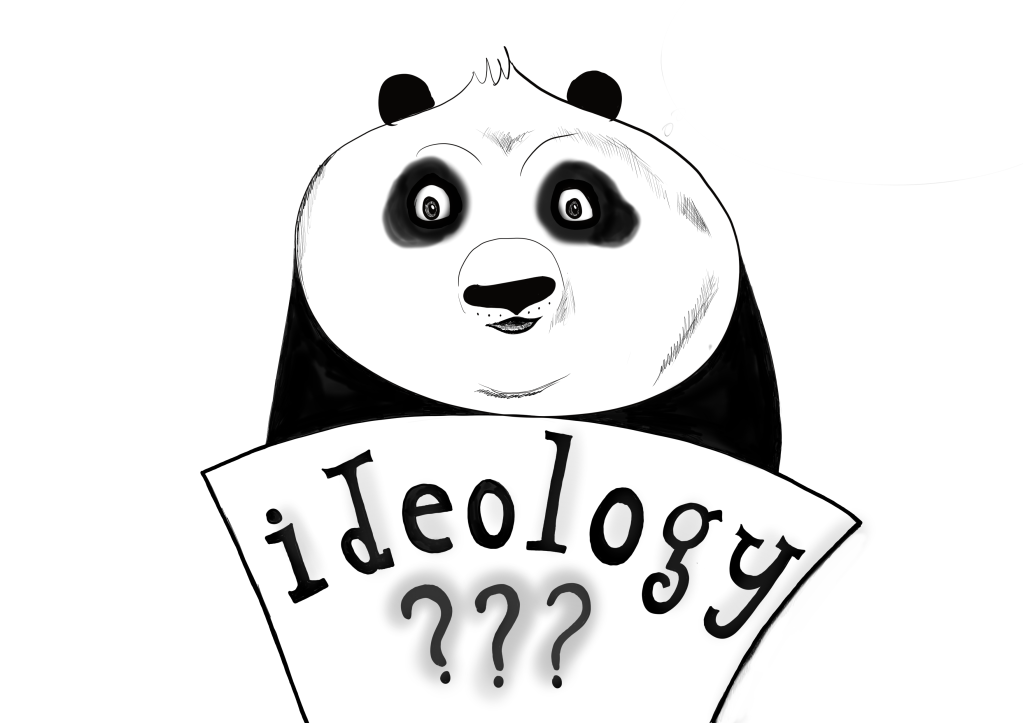
Have you ever asked yourself if 2008’s DreamWorks animation Kung Fu Panda could be read as “a somewhat naive, but nonetheless basically accurate illustration of an important aspect of Lacanian theory”? Well, if you are still reading Žižek with me, hello and welcome to page 69, section title Les non-dupes errent!
Slowly making my way through Living in the End Times, I could not have been more excited to start reading a subpart where the author’s analytical might is focused on one of the funniest cartoon blockbusters from my childhood, namely Kung Fu Panda (2008, John Stevensoon and Mark Osborne). Žižek has once and for all put a fictional goose’s “special noodle soup” as a serious intellectual example in my head and there is no going back…
Žižek starts by reminding us of the basic plot: “Po is a panda who works in a noodle restaurant owned by his goose father Ping, in the Valley of Peace in China. He is a Kung Fu fanatic with secret dreams of becoming a great master in the discipline; his weight and clumsiness however, seem to make this goal unattainable. Ping dreams that one day Po will take over the family restaurant and eagerly awaits the right moment to reveal the secret ingredient in his family’s noodle recipe. Meanwhile, Master Oogway, the wise tortoise and spiritual guide of the Valley, foresees the return of Tai Lung, a fierce leopard warrior and former student of Shifu, the red panda master. Oogway fears Tai Lung will break free from prison to menace the Valley of Peace, so he calls for a ceremonial selection to choose the powerful Dragon Warrior, the only one capable of defeating Tai Lung. […] to everyone’s shock the old master tortoise designates Po the Dragon Warrior.”
Once designated the Dragon Warrior, we see a classic transformation story of a clumsy protagonist somehow becoming incredibly strong - in this case Po reveals himself to be capable of impressive physical feats when motivated by food. Afterwards, having become a worthy enough fighter, Shifu finally gives him the sacred Dragon Scroll, which promises great power to the possessor. But upon opening it, the panda discovers that the scroll is just a blank reflective surface. Both him and Shifu immediately despair and Po even initially gives up trying to face the enemy.
Then, however, comes a key moment: Po’s father decides to cheer him up by finally revealing the secret ingredient of the family’s noodle soup: nothing.
Things become special, he explains, because people believe them to be special. Realizing that precisely this is the very point of the Dragon Scroll, Po rushes off to challenge Tai Lung.
During their long-awaited battle, Po fights well but Tai Lung is obviously stronger and eventually succeeds in taking the sacred scroll. When he sees it is empty he fails to understand its symbolism and surrenders to a violent frustration, which allows Po to counter-attack and defeat him. Finally, Po becomes the village’s hero! (Surprise, surprise)
Now, let’s start from this metaphor of the special soup or the empty scroll. As Po himself figured it out - both carry the same meaning. Here, especially given the film is made for kids, it is all too easy to interpret the message as purely psychological. I find it even borderline New-Age-manifest-y: if you believe in yourself, that’s all that matters! If you believe that your soup is the best in town and exert that confidence people will gravitate towards you and believe it as well!
However, Žižek shows there may be more. A soup can be special not through its ingredients put together in a bowl but through an ineffable je ne sais quoi that “cannot be adequately translated into any explicit positive determinations.” That is objet petit a in Lacan’s terms, or the object-cause of desire.
Note that I am not an expert in Lacanian theory but I am simply taking you through both the chapter in place and my train of thought as I was reading it. We will later get to the answer of whether Kung Fu Panda is indeed proto-Lacanian or not.
The je ne sais quoi reminded me of an old Black Mirror episode - “Be Right Back.” In it, a young woman named Marta discovers an AI chatbot, which perfectly simulates her recently deceased boyfriend Ash. At first, the AI only chats but later Marta upgrades to a version in which the software is able to talk on the phone with her dead partner’s voice, and ultimately, upgrades to a synthetic double - a human-robot-double of Ash. After some time of comforting herself by interacting with this double, Marta realizes that even if you take all of her boyfriend’s properties, qualities, features and synthetically recreate a double, that will never be them. You cannot recreate the je ne sais quoi.
You have this objet petit a, which is in nature immanent to language. The fact that the special ingredient to Ping’s soup is nothing holds in itself a repetition. Instead of saying “nothing” one could say the special ingredient is the special ingredient itself. Therefore, the signifier falls into the signified itself. Ash is not just a combination of his qualities - being a caring person, funny, etc. Nor is he the synthesis of words, actions, performances. The proper answer to “Who is Ash?” is simply - Ash.
This signifying repetition generates the specter of an ineffable X ‘beyond words.’ The paradox is thus that language reaches beyond itself, to the reality of objects and processes in the world, when it designates these objects and proceeds by means of clear denotative/discursive meanings; but when it refers to an ineffable transcendent X ‘beyond words,’ it is caught in itself.
Therefore, when Kung Fu Panda reveals that the secret knowledge of the Dragon Scroll is nothing, or is only itself, the film plays into Lacan’s theory that the objet petit a is ultimately an illusory attraction, “a stand-in for the void at the very heart of the symbolic order.” However, we are presented with two possible reactions to the emptiness of the scroll. On the one hand, there is the tiger Tai Lung who miserably fails to get the symbolism. What happens then is that he continues to act as if there should be another meaning, as if the signified cannot be equal to the signifier. The tiger twists and turns the scroll looking at it from all angles until he loses control. He is overwhelmed by the need to grasp the ungraspable.
This is how capitalism works, this is the material efficiency of capitalist ideology: even when we know how things are, we continue to act upon our false beliefs
On the other hand, there is Po who truly realizes “to make something special you just have to believe it’s special” (even though it took him a minute). He came back to fight a seemingly undefeatable enemy. By understanding the symbolism of the emptiness Zizek hints that Po could have realized a “wild traversée du fantasme, breaking its spell.” After all, it is a childrens’ film as Po does defeat Tai Lung and becomes the superior warrior. He achieves this not without any physical effort or training, but still with significantly less years of kung fu practice compared to the other warriors in the film (the Furious Five), hence reaffirming that the main factor was him making himself special through belief.
Now, Zizek ultimately returns to answer the initial question of “Could Kung Fu Panda be read as ‘a somewhat naive, but nonetheless basically accurate illustration of an important aspect of Lacanian theory’?” And his answer is essentially “Not really.” Or, if I may rephrase in Gen Z language: simply “-ish.” If we take “Believe in yourself and you’ll achieve the impossible!” as the final conclusion of the film, that is definitely not the point of Lacanian psychoanalysis. Po doesn’t quite traverse the fantasy.
But after all it is only a childrens’ movie. For Zizek, the rupture with Lacanian theory is what he calls the “elementary wisdom” Kung Fu Panda preaches, which is what I initially intuited as “New-Age-manifest-y”.
To traverse the fantasy as far as I understand Lacan’s term, is to cease assuming that the Other has taken the ’lost’ object of desire (objet petit a). So to say, to rupture with the idea of a particular substance of the je ne sais quoi. While if we depart from this definition, it still seems to me that there were moments, which appear to capture a genuine traversée du fantasme. When Po hears his father’s secret ingredient is nothing and then looks at the scroll with new eyes, he is able to connect the two: on the one hand, a form of object-cause of desire reveals itself as an empty signifier, which he has considered as solid knowledge probably since early childhood (the uniqueness of the praised soup the whole village loves) and on the other, the object-cause of desire representing the deepest wisdom in the fictional universe also reveals itself to be purely self-reflective. He thus breaks the spell. Maybe it is not that Po realizes he just needed to have more confidence in himself but he understood that the signifier falls into the signified, the very basis upon which we go through life is more fluid than the panda thought!
It is not that nothing is real anymore, but that the properties he attributed to the idea of a Dragon Warrior or more broadly to the idea of a Kung Fu hero aren’t anything tangible he could have just accessed even through the most powerful spiritual text. The same way that the dead Ash couldn’t be accessed by Marta even through the most powerful technology we could ever imagine. With that realization at hand, doesn’t it follow that one is liberated from the fantasmatic allure? Po is simply free from the fear of not possessing the legendary characteristics as he realizes they are self-reflective abstractions.
Yet finally, my intuition tells me that even if we traverse the fantasy we won’t traverse the physical boundaries our bodies dictate. Therefore, the heroic defeat of Tai Lung presupposes Po underwent a form of miracle allowing him to surpass fleshly limitations. While it would have been completely crazy for DreamWorks to do, my take is that Po should have died in trying to defeat the evil leopard! Not much more to say here - just my hot take.
To follow good old tortoise Oogway’s way of being and accept the vanity of all reality, I’ll end on this somber note…