Get an email when a new post is published. Confirm your email to start.
Unsubscribe anytime.
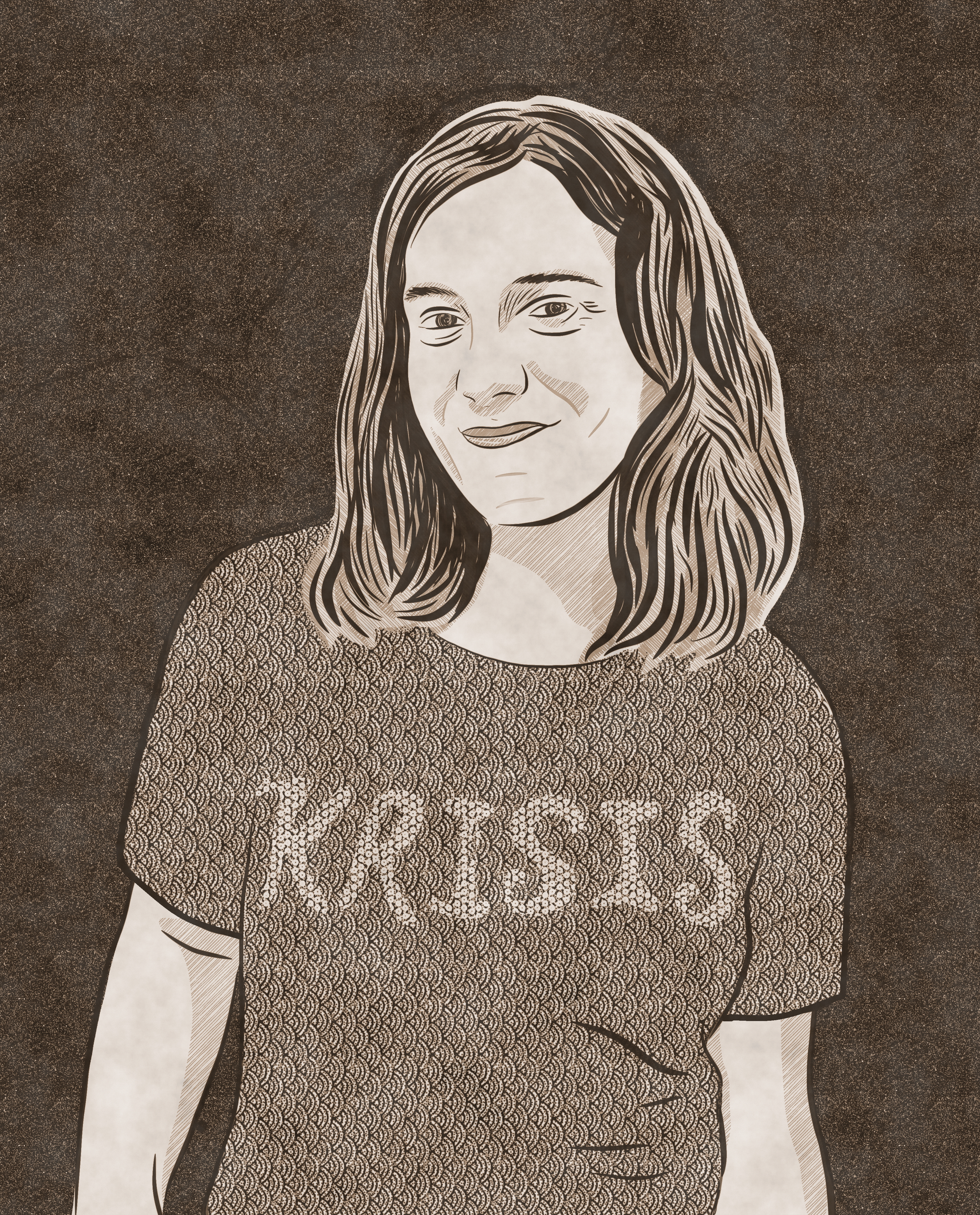
My name is Krisi…
…and I’m often in crisis (existential, interpersonal, illusory—you name it.)
Here is where I share my readings that get me through the turbulent, calm, wonderful, silly, and often comicotragic days. And you know what? I thought it would be nice to share the interesting stuff I read and my (maybe?) interesting thoughts.
Would Kierkegaard say Roland Barthes Was Anxiously Attached?#
In reflecting on the Adorable, the unique quality that draws us to our objects of desire, 20th-century French theorist Roland Barthes writes in A Lover’s Discourse:
Herein a great enigma, to which I shall never possess the key: Why is it that I desire So-and-so? Why is it that I desire So-and-so lastingly, longingly?
Or to paraphrase it the way Sex and the City protagonist Carrie Bradshaw would have said it: I couldn’t help but wonder… Why am I utterly and ridiculously obsessed with Mr. Big?
Barthes, Bradshaw, and even Žižek would probably agree that the enigma has no real answer unless seen as a tautological statement: What I love about Mr. Big is his unique quality of being Mr. Big himself. This “fatigue of language,” as Barthes calls it, makes it so that “[…] what is proper to the desire, can only produce impropriety of the utterance.” Ah, thinking about love and desire… Sure, using one’s words may be a doomed endeavor, but the fact of the matter is that I am still having experiences, and I need to describe them! Famously, that’s what my blog is about.
Inspiration found me through sporadically reading Barthes’ A Lover’s Discourse, as well as a Blythe Roberson’s comedy-philosophy How to Date Men When You Hate Men. Which was, by the way, GIFTED to me??? A bit similar to gifting a treadmill or soap, like, what are you trying to tell me?
How to Date Men When You Have Read Too Much Philosophy#
But anywho, this spark of inspiration has led me to faux-academize my intuitions, hardships and occasional triumphs in the modern world of dating, since for better or worse, I have not been significantly partnered in a while (but neither was Roland Barthes when he wrote A Lover’s Discourse, so shut up!)
Ergo, I decided to go back on the quest for love, or “on the apps” as kids say these days. From this Hinge iteration onwards (as we all know the app is made to be uninstalled, then reinstalled 50000 times), I decided to reject the commonly established terminology of referring to dudes as “matches”, “dates”, “situationships” or “crushes”. No, no, no. I am an intellectual. That makes people my “objects of desire”. Or for those who have read Bunny by Mona Awad: “my drafts”, “my darlings”, “my bunnies” are also acceptable alternatives, pointing to what in the plotline of Bunny are soulless bunny-humanoid mutants, emerging from a violent art project.
That said, if you who are reading this are the draft who stood me up on November 8th, for me, you shall always be a soulless bunny-humanoid mutant with a receding hairline!!!
I don’t want therapy, I want revenge!
My life is Just an Anthropological Experiment I Am Not Being Paid For#
Just last week, as I was giving dating updates (of being stood up) to one of my guy friends, who has never in his life been on a dating app (the lucky bastard!), I realized he deemed my stories important from an anthropological point of view: rituals, ethics, faux-pas, matching, swiping, passing on Whatsapp, ghosting… Modern dating is a world of its own. A jungle to be precise. So, I thought – if my personal experiences can tell us anything anthropologically or philosophically interesting about the collective reality of dating as a woman in your 20s, in the year 2025, primarily oriented towards men – alright, put me in a zoo. I volunteer!
But before we all have even arrived at the dating scene, we (as in the collective of women similar to me in privilege, culture, $$$ & other societal characteristics) are all already influenced by mostly made-up narratives, books, TV, The Bachelor and so forth. And then there are some particular details, which contributed to the way I, myself (as a concrete human weirdo), have been molded into the confused modern woman I am still constantly becoming.
My catalog of contributing factors is including but not limited to:
A random yet lucky elective I took in Sciences Po Bachelors: La séduction dans les arts: politique et intimité.
My parents always asking why am I rejecting the long line of suitors who must be begging to date me (I dare you to find them, Mom)
Myriads of rewatchings of Sex and The City episodes, which let’s be real, has been the single most influential piece of art for me, and for my equally lost female friends.
Boys breaking up with me.
My brother-in-law’s pick-me-up speech after my first boyfriend broke up with me: I was profoundly convinced that I would never ever find anybody to have sex with ever again!! Scary. But this man, embodying the same irrefutable rational certainty he uses when talking about train models, computer servers or Marxism, told me that if I ever had a doubt of whether a straight guy wants to sleep with me, a FEMALE, one should always assume YES, unless the guy has a six-pack, in which case one should assume MAYBE 🙏
So, within this list, my faithful readers, lies partly an answer to “Why is it that I am So-and-so?” – how I have arrived at the strange conviction that I am, at once, the object of everybody’s desire (aka everybody has a crush on me) and yet, fundamentally unlovable. Ontologically doomed for perpetual emotional malfunction!
In the academic context of my La seduction dans les arts (Seduction In Arts) class at Sciences Po I read Diary of a Seducer by Danish philosopher Søren Kierkegaard. His oeuvre installed (or confirmed?) in my head the narrative, shared by How to Date Men When You Hate Men, that boys are manipulating me over text with a psychological-experiment-level of efficiency!
Let me set the scene: He was a bourgeois bachelor in early 19th-century Copenhagen. She was a respectable middle-class lady. He was a punk. She did ballet. What more can I say?
In Diary of a Seducer, Kierkegaard describes Johannes, a cunning aesthete, who meticulously plots the step-by-step seduction of a young woman named Cordelia. How does he do that before pick-up-artistry, you may be wondering? Well, by writing her a plethora of well-thought-out letters! (Aka the ancestors of texts)
We could say that Johannes saw dating as a sick aesthetic project – provoking Cordelia’s desire and affection with a combined psycho-attack of poetic letters, strategic withdrawal, timing his responses and treating the objective of her falling in love with him as a behavioural study:
What I feared most was that the whole process might take me too long. I see, however, that Cordelia is making great progress; yes, that it will be necessary to mobilize everything to keep her mind on the job. She mustn’t for all the world lose interest before time, that is, before the time when time has passed for her.
Once he had achieved his goal - her total emotional devotion - he goes “Huh, that was fun. Now I shall continue to wistfully stroll in Copenhagen and be an aesthete. "
Well, that sounds awfully familiar… If you take my last couple of dating attempts, you’d think those bunnies read Kierkegaard! Yet, I’m almost sure they don’t know who that is… So, I am guessing they all just naturally came to the agreement that a collaborative academic paper needs writing: A Study on Mating Selections In a Time of Krisis.
Two more theories that would literally make more sense than the last dudes I’ve dated being real people:
A) I died during my first caving expedition and I was sent to the Bad Place.
B) I live in a VR-simulated environment running on a buggy algorithm, which allows for players to court me only until I start liking them back, at which point they spontaneously combust or get transferred to another side quest.
Even as he obsessively asks himself why he is not loved, the amorous subject lives in the belief that the loved object does love him but does not tell him so.
— Roland Barthes (the OG Delulu King)
Unlike Kierkegaard who writes the main point of view as that of the lover-seducer holding all the power, Roland Barthes, a major 20th-century literary theorist, paints a way more identifiable portrait – a lover who finds themselves powerless in sight of their beloved: the figure “[…] of someone speaking within himself, amorously, confronting the other (the loved object), who does not speak.”
Barthes, like me, was a softie.
In A Lover’s Discourse, he describes a short fragmented path of a riddled man, who intensely experiences the good and the bad of his amorous relationship. And doing so in an almost uncomfortably honest way, positioning himself as the one who is madly and anxiously in love but whose feelings aren’t sure to be reciprocated. Similar to this type lover figure I also found Giovanna, the female protagonist of The Lying Life of Adults’s, who was portrayed with an intensely sincere inner world, in which she saw herself as the amorous subject convinced her object of desire is always out of reach; that she had to read, improve herself, learn about communism and religion in order to not appear unintelligent in front of her crush!
I think growing up I never believed people other than me had obsessive all-consuming crushes (or deep inner worlds of their own, for that matter.) That being so, I later found myself being most drawn exactly to fictional characters or, like in Barthe’s case – unnamed discursive personas, who carry their romantic insecurity so courageously that it is poetic. They aren’t always graceful but there is just something incredibly cathartic about reading a way more beautifully phrased version of:
Ahhhghh I have so many feelings, I don’t know what to do with them! I am anxious! Is he going to text me? I bet he’ll never like me back!!!
That, but make it a well-written 1978 semiotic analysis:
Am I in love? – yes, since I am waiting. The other one never waits. Sometimes I want to play the part of the one who doesn’t wait; I try to busy myself elsewhere, to arrive late; but I always lose at this game. Whatever I do, I find myself there, with nothing to do, punctual, even ahead of time. The lover’s fatal identity is precisely this: I am the one who waits.
— Roland Barthes
We moderns (or those who are too modern, if you ask me) would simply diagnose Roland Barthes as having an anxious attachment style and his lover as being an avoidant. It makes partial sense that we see the world through this lens, since the anxious / avoidant distinction is the #1 self-help pop psychology tool that has addressed our entire generation’s issues with dating and commitment! And I’m not saying it isn’t often on point.
But that is where my innate intuition about people simply having authentic feelings and experiencing them gets intertwined with the noise of dating in our day and age. Sure, maybe the author was indeed in a toxic relationship, which was forcing him into the role of the one who anxiously waits, for whom trying to appear nonchalant was a theatrical game destined to fail. Or, maybe, just maybe, he also captured something genuine about the human condition when in love… Be it securely, anxiously or avoidantly attached (+[insert other options if they exist]), ultimately the lover’s path is composed of many and complex episodes, many of them featuring some form of anxiety. If you have ever been strongly enamoured with somebody – a crush, a partner, a bunny – you likely have gone through deliriums, ambiguity, stress.
And as Blythe Robertson reminded me recently, dating tells your brain: “I am not a fish! Fish definitely don’t feel that way!” It’s all part of the human experience.